

Recent Articles Education Facilities
- Details
- Parent Category: Articles

From Hand Signals to Universal Design: AccessConsultants.asia’s Commitment to True Inclusion in Malaysia
In everyday life, when words fail us — whether speaking to someone from another country, across a noisy room, or in a high-stress moment — what do we instinctively do? We start using hand signals. We gesture, point, mime, and rely on visual cues to bridge the gap. This simple human response reveals a profound truth: a language barrier shares striking similarities with deafness. Both situations force people to adopt alternative means of communication — visual, gestural, and non-verbal — to connect and participate.
At AccessConsultants.asia, we see this parallel every day in our work as a disability access consultant and universal design specialist. Just as language barriers compel creative adaptation, physical and sensory barriers in the built environment push people with disabilities — including those who are deaf or hard of hearing — to navigate unnecessary challenges. Our mission is to eliminate those barriers through thoughtful, inclusive design so that everyone can participate fully, without having to “make do.”
Our Deep Commitment to Inclusion
We are committed to creating built environments where no one is left behind. Operating as Sydney Access Consultants (Malaysia) PLT from our Kuala Lumpur office, we bring proven international expertise while maintaining a strong Malaysia-first approach. Our team of Malaysian-registered architects and access specialists understands local contexts, cultural sensitivities, and regulatory realities.
We believe universal design is not just about compliance — it is about dignity, equity, and economic sense. Whether for mosques, commercial buildings, public facilities, or residential developments, inclusive spaces benefit everyone: families with young children, seniors, tourists, and people with disabilities alike.
Our Initial Approach: Practical, Collaborative, and Local
From day one, we have focused on delivering tangible value through four integrated pillars tailored to Malaysia’s evolving landscape:
- Compliance Advisory & Design Reviews — Independent access audits, detailed compliance matrices, and practical recommendations aligned with MS 1184:2014 (Universal Design and Accessibility in the Built Environment) and UBBL By-Law 34A.
- Regulatory Strategy & Approvals Support — Clear roadmaps and liaison with key authorities including DBKL, JKM, and KPWKM to streamline approvals.
- Capacity-Building Training — Hands-on workshops for architects, engineers, and facilities managers, using real Malaysian projects as live case studies.
- Implementation Support — On-site guidance and collaborative delivery through partnerships with local architectural firms.
Our hybrid model combines Australian best practices in accessibility (NCC and AS 1428 standards) with deep local knowledge. Led by a core team of PAM- and LAM-connected professionals in Kuala Lumpur, we ensure solutions are practical, cost-effective, and culturally appropriate for Malaysia’s multicultural society.
Language Barriers, Deafness, and the Power of Alternative Communication
The analogy between language barriers and deafness is particularly powerful. When verbal communication breaks down, we naturally shift to gestures and visual signals — the very foundations of sign language and visual communication used by Deaf communities. Poorly designed buildings create similar “communication breakdowns” in the physical world: missing visual fire alarms for deaf users, inaccessible information signage, or spaces that exclude people who rely on lip-reading or clear sightlines.
Universal design addresses this by providing multiple means of access and communication from the outset — wide corridors, high-contrast signage, hearing loops, visual alarms, and intuitive layouts. These features don’t just help people with disabilities; they make spaces better for everyone, just as clear, simple language helps both native and non-native speakers.
Our Future Strategy: Scaling Inclusion Across Malaysia, Sydney & Perth
Looking ahead, we are accelerating our impact with a clear, ambitious strategy:
- Expanded Training & Thought Leadership — Roll out modular certification programs for Malaysian architects and developers, preparing them for stronger enforcement under the upcoming PwD Act 2008 amendments (expected in 2026). These will include practical modules on MS 1184 compliance, heritage-sensitive design, and inclusive communication features.
- Deeper Local Partnerships — Formalise more MOUs with PAM and LAM practices to co-deliver projects and embed accessibility early in the design process.
- Multimodal & Multicultural Accessibility — Extend our own digital presence (including this website) with enhanced multilingual support, visual aids, and inclusive content — mirroring the alternative communication strategies we advocate in the built environment.
- Geographic Growth — Strengthen our core operations in Kuala Lumpur while supporting clients in Sydneyand the rapidly emerging Perth market. This creates a powerful Asia-Pacific network for knowledge sharing and consistent high standards.
- Policy Engagement — Continue contributing insights to government consultations as Malaysia moves toward enforceable accessibility standards, time-bound compliance, and meaningful participation for the OKU community.
Our goal is simple yet transformative: to make inclusive design the default in Malaysia, not an afterthought.
Partner With Us for a More Inclusive Future
Whether you are an architect seeking practical guidance, a developer preparing for regulatory changes, or a government agency aiming to lead by example, AccessConsultants.asia is your trusted partner.
Contact our Kuala Lumpur team today for an independent access audit, design review, or tailored training session. Together, we can move beyond hand signals and temporary workarounds toward environments where everyone communicates, participates, and thrives — naturally.
Ready to break barriers? Call +60 3-2779 7117 or email This email address is being protected from spambots. You need JavaScript enabled to view it. Visit: AccessConsultants.asia
- Details
- Parent Category: Articles
From Mousetrap Mayhem to Schoolyard Ingenuity: The Lost Art of Playful Design
Back in the 1960s, kids across the world (including this author) spent hours building wildly elaborate contraptions in the classic board game Mousetrap. Originally released by Ideal Toy Company in 1963 and inspired by Rube Goldberg's cartoonish chain-reaction machines, the game turned a simple marble into a hilarious cascade of tipping buckets, swinging boots, and a final cage drop. It was pure mechanical joy —part engineering, part slapstick comedy. (Later editions appeared under Mattel/Hasbro branding, which is why many remember it that way.)
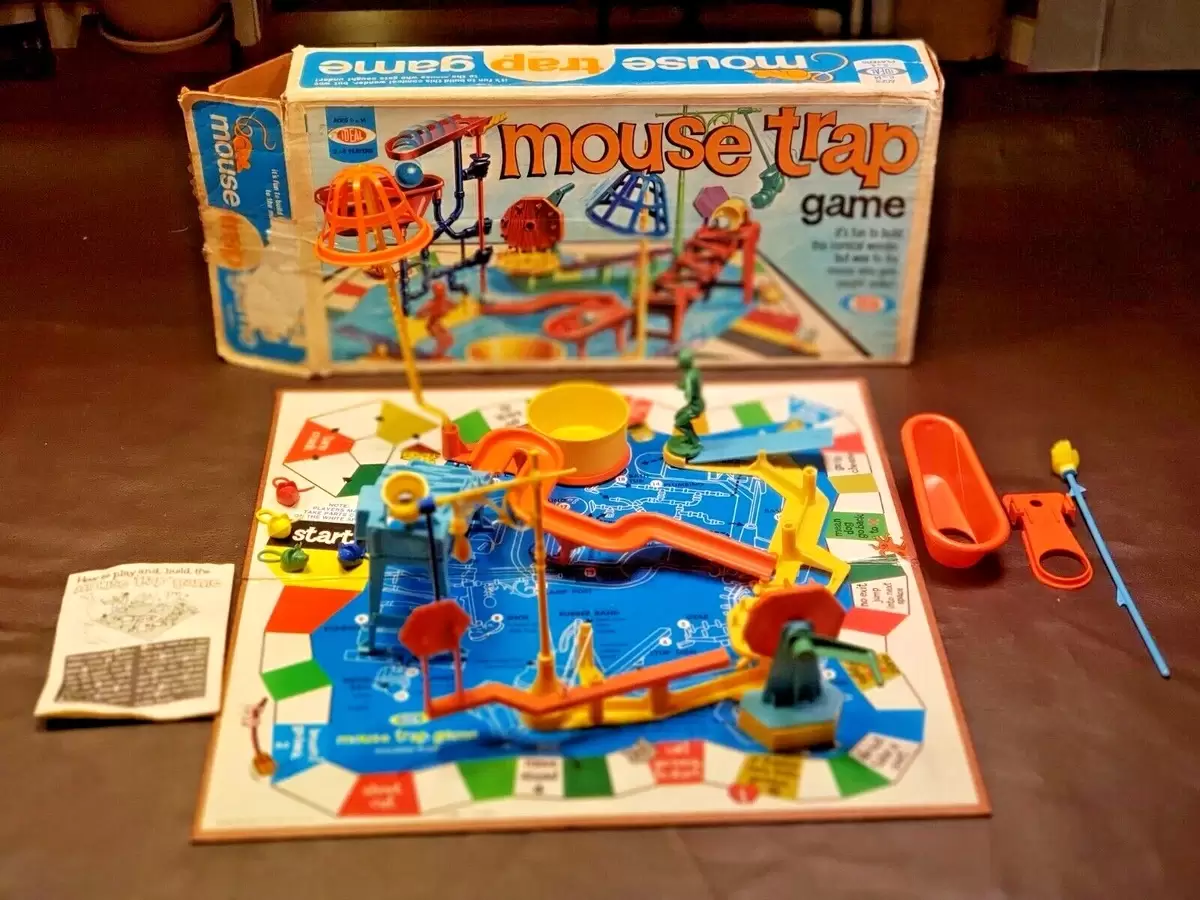
Fast-forward to the early 2000s. As architects working on upgrades for New South Wales public-school toilet blocks, we faced a very different kind of chain reaction: the daily chaos of hundreds of students, harsh weather, and the relentless forces of graffiti, vandalism, and neglect. The brief was clear and demanding:
• Robust materials that could withstand kicks, knocks, and years of heavy use
• Easy-to-clean surfaces (no hidden crevices for grime)
• High-security fixtures and vandal-proof hardware
• Graffiti-resistant coatings
• Excellent natural lighting and cross-ventilation
• A generous number of cubicles for both boys and girls to cut down on queues
We delivered dozens of these facilities across Sydney and regional NSW. They were functional, durable, and by the standards of the day—quite progressive. But one recurring headache stuck in everyone's mind: tennis balls. Every school seemed to have a roof or gutter system that acted like a magnet for stray balls from the playground. They lodged in downpipes, blocked drains, and turned routine maintenance into an endless game of retrieval. Gutter-cleaning crews in Australian schools still report staggering numbers of tennis balls, soccer balls, and other projectiles every year.
One project in particular became legendary in our office. The site sat in a precinct where a certain Australian Prime Minister lived at the time. The deadline was tight, the scrutiny high, and the tennis-ball problem was especially acute. Instead of the usual pitched roof with standard gutters, we designed a custom roof profile that turned the problem into delight. No matter where a tennis ball landed, the gentle slopes and curved channels would funnel it safely back to a single collection point at ground level-separated from leaves and rainwater. It was a quiet Rube Goldberg moment in architecture: a single, elegant gesture that solved a practical nuisance while injecting a spark of fun into an otherwise utilitarian building.

We thought we were brilliant, of course. Architect's designs need to stick around for say a hundred years, whereas a 30-second advertisement is a fleeting concept. The fact is, we architects have to be overly arrogant to believe that we can impose our ideas on society for the lifetime of a building. But hey, it comes with the job, and the kids would love it. Maintenance would be simpler. And it cost next to nothing extra.
Alas, conservative minds prevailed. "Something more traditional would be more suitable," we were told. The playful roof was shelved, and we delivered a sensible, pitched-roof solution with conventional gutters and downpipes. It worked perfectly—secure, well-ventilated, easy to clean, and appropriately discreet for its high-profile location. But it lacked that spark. I know other high-profile architects would tip their hats and walk away rather than compromise their vision. I guess that's the difference between a fountainhead and a seasoned practitioner. Our job at the end of the day is to make our government client representatives look good. That idea, we fully embrace without regret. Our plans get built.
Looking back, the episode feels emblematic of a broader tension in public architecture. We design for safety, durability, and cost-effectiveness—and rightly so. Yet we too rarely leave room for joy, whimsy, or the small surprises that make everyday spaces memorable. The Mousetrap roof would have been a gentle reminder that buildings don't have to be solemn
to be serious. A ball returned safely to the playground instead of being trapped in a pipe is a tiny victory for cleverness over conformity.
There are encouraging exceptions today—playful rolling-ball installations in public plazas, undulating roofs that invite interaction, even schools with climbing walls and colour-coded wayfinding that turn navigation into a game. But we could use far more of that spirit.
So here's a modest proposal: the next time you're specifying a roof, a playground, or a public facility, ask yourself—could a little Mousetrap logic make it better? A chain reaction that ends, not in capture, but in delight.
Because good design doesn't just work. Sometimes, it should also make you smile.
FAQ – Playful Design & Rube Goldberg Architecture
What is Rube Goldberg architecture? It applies chain-reaction principles to buildings, using motion and mechanics to solve problems in engaging, often humorous ways.
Why do tennis balls get stuck in school gutters? Playground activity sends balls onto roofs, where standard gutters trap them, leading to frequent blockages.
How can playful design improve school bathroom facilities? Features like better drainage, natural light, ventilation, and subtle interactive elements enhance durability, hygiene, and user experience.
Where can I learn more about the Mousetrap game? The Wikipedia entry on Mouse Trap offers a detailed history: https://en.wikipedia.org/wiki/Mouse_Trap_(board_game)